There are a lot of things that fountain pen users look at when choosing an ink to use. Is an ink wet or dry? [Wetter inks have a faster flow while dry inks have a slower flow and more surface tension.] They also ask about the Three S’s .Is the ink a shading ink? [A result of a fountain pen ink pooling in certain parts of a letter when writing, so that the color and saturation of the ink appears different within a single letter or word.] Does the ink sheen? [When the fountain pen ink pools another color can be seen on top of the ink, especially when looked at in different light angles using certain paper types.] And the final S – does the ink shimmer? [Fountain pen ink that has small particles of glitter mixed in.] A common aspect that is also looked at is how water resistant the ink is. [Water resistance means that a portion of the ink will remain after being subjected to water. This might only be one ingredient of the ink, leaving behind a legible remnant with little or no representation of the original color.]
My current collection of bottled ink has five shimmering inks. At least one of my inks has some shading properties and another seems to have sheening properties that are dependent on the amount of ink put on the paper. Three of my inks are highly water resistant (I’d expect so since they are document inks)
There is another aspect that of fountain pen ink that I have decided to explore. That is the chromatography.
In chemical analysis, chromatography is a laboratory technique for the separation of a mixture into its components. The mixture is dissolved in a fluid solvent called the mobile phase, which carries it through a system on which a material called the stationary phase is fixed.
Wikipedia
In the case of fountain pen inks I am looking at the varying colors that make up each ink by putting fountain pen ink on a highly absorbent piece of paper then using water as the fluid and observing the different colors in the ink separate as they travel up the paper.
For my experiment I used Chromatography Paper Strips that I purchased on Amazon. After drawing a line of ink on each strip with either an inked fountain pen or a dip pen I attached the strips to a wooden dowl that I could suspend over a small bowl of water making certain that the ink line was not submerged when the paper touched the water. I set a timer and retrieved the paper at the 1.20 minute mark and let the water to continue working its way up the paper then waited for it to dry.

Inks Tested
Top Row
- Wearingeul Twelfth Night, a sliver shimmering pink ink (bottle)
- Diamine Firefly, a gold shimmering orange ink (bottle)
- Ferris Wheel Press The Fluttering Heart, a gold shimmering pink ink (bottle)
- Platinum Black, a standard black ink (cartridge)
Middle Row
- Diamine Syrah, a wine colored ink (bottle)
- Pilot Iroshizuku Ka-Jaku, a teal colored ink (bottle)
- Jacques Herbin 1670 Stormy, a gold shimmering grey ink (bottle)
- De Atramentis Black Currant, a scented purple ink (bottle)
Bottom Row
- Diamine Dark Forest, a dark green ink (sample vial)
- Noodler’s Ink Bad Gator Green, a green ink (sample vial)
Note: There were a few inks in my current ink collection I did not test – my document inks as I already know from a previous chromatography trial that they do not separate and a shimmering ink that I intend to give away or parse out samples from that I do not intend to use further.
My Observations and Thoughts
I really need to cultivate more patience when it comes to waiting for results. Though this test was meant to separate colors it also showed me which inks are really not water resistance as the lines completely vanished as the water progressed up the strip. The two shimmering pink inks surprised me. The Fluttering Heart leans more brown than pink when compared side by side to Wearingeul Twelfth Night and in the chromatography it seems that the difference is the addition of yellow. I was also surprised to see the yellow and pink in Stormy Grey show up.
After looking closely at the dried strips of paper it quite surprised me to find that many of the inks that seemed to fade completely from the origin line displayed very light grey. I don’t think this is an indication of color but perhaps it is an indication of the inks lubrication. I may look into this further in the future, but for now it’s just an interesting observation.
Overall I wasn’t really surprised or wowed by the results of these inks. Partially because this was my second attempt at chromatography testing with these inks and partially because I have come across some amazing chromatography examples from other pen and ink enthusiasts.
Bonus
One of the many reasons I decided to explore chromatography was that I wanted to be able to fully use up the inks that I own and one of the ways to do that is through art. I came across Nick Stewart on Instagram (quinkandbleach) and was absolutely taken with the idea of creating art using chromatography.
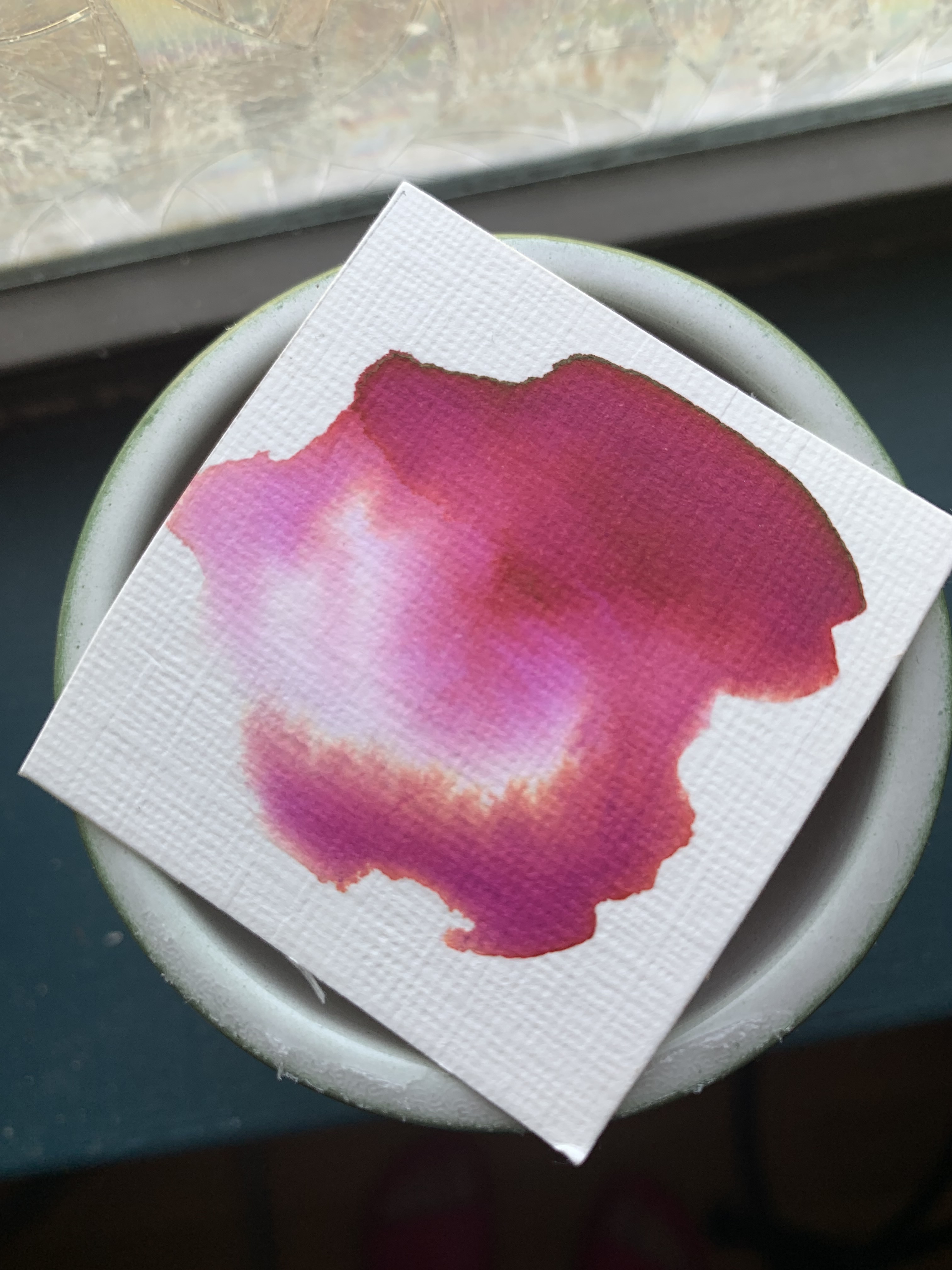
While this isn’t quite the paper finish that Nick recommends in his tutorials (it’s not rough or rough enough) it is the right weight of paper – 200lb. This was one of my first attempts to see if I could do chromatography swatch. It didn’t work out (in this case I really think it was the finish of the paper that made the difference.) But I like it nonetheless. You can actually see the brilliant orange and the bright pink come through in Diamine Syrah which is one of, if not absolute, my favorite inks.
Much love,
Charlie
P.S. If you happen to have ink samples you no longer need or want or are just in the habit of sharing inks with other enthusiasts let me know. I’d be happy to share from my small collection. If you use the Fountain Pen Companion you can find me under Charlie M to look at my ink collection.

 Loose Endings Studio